
The KDHRC Step Challenge has wrapped up, and it is time to announce a winner!…
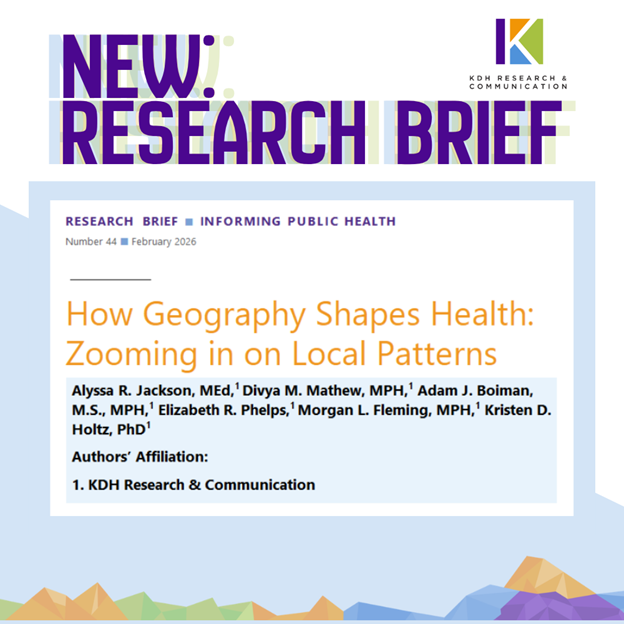
New Research Brief: How Geography Shapes Health: Zooming in on Local Patterns
Health is shaped by more than individual choices—it is deeply influenced by where people live. KDHRC’s newest research brief, “Geography as a Determinant of Health: Understanding Place-Based Differences in Health Outcomes,” examines how location drives disparities in health and highlights opportunities for more targeted public health solutions.
Statewide data plays an important role in identifying broad trends and guiding resource allocation. However, these high-level views can mask meaningful differences within states. Health risks and access to care often vary widely across regions, counties, and even neighborhoods—differences that only become visible when data is examined at more local levels.
Geography plays a critical role in shaping access to essential resources such as health care, nutritious food, safe housing, transportation, and economic opportunity. These factors—often referred to as social determinants of health (SDOH)—are not evenly distributed across communities. As a result, individuals living in different neighborhoods, counties, or regions may experience vastly different health risks and outcomes, even within the same state.
Addressing these types of localized disparities requires a place-based approach. By “zooming in” beyond statewide data to regional-, county-, and census-tract levels, public health professionals can better identify where needs are greatest and tailor interventions accordingly.
KDHRC uses these insights to design targeted, community-informed strategies that improve health outcomes and advance equity.
Read our full research brief here: How Geography Shapes Health: Zooming in on Local Patterns

Related Posts