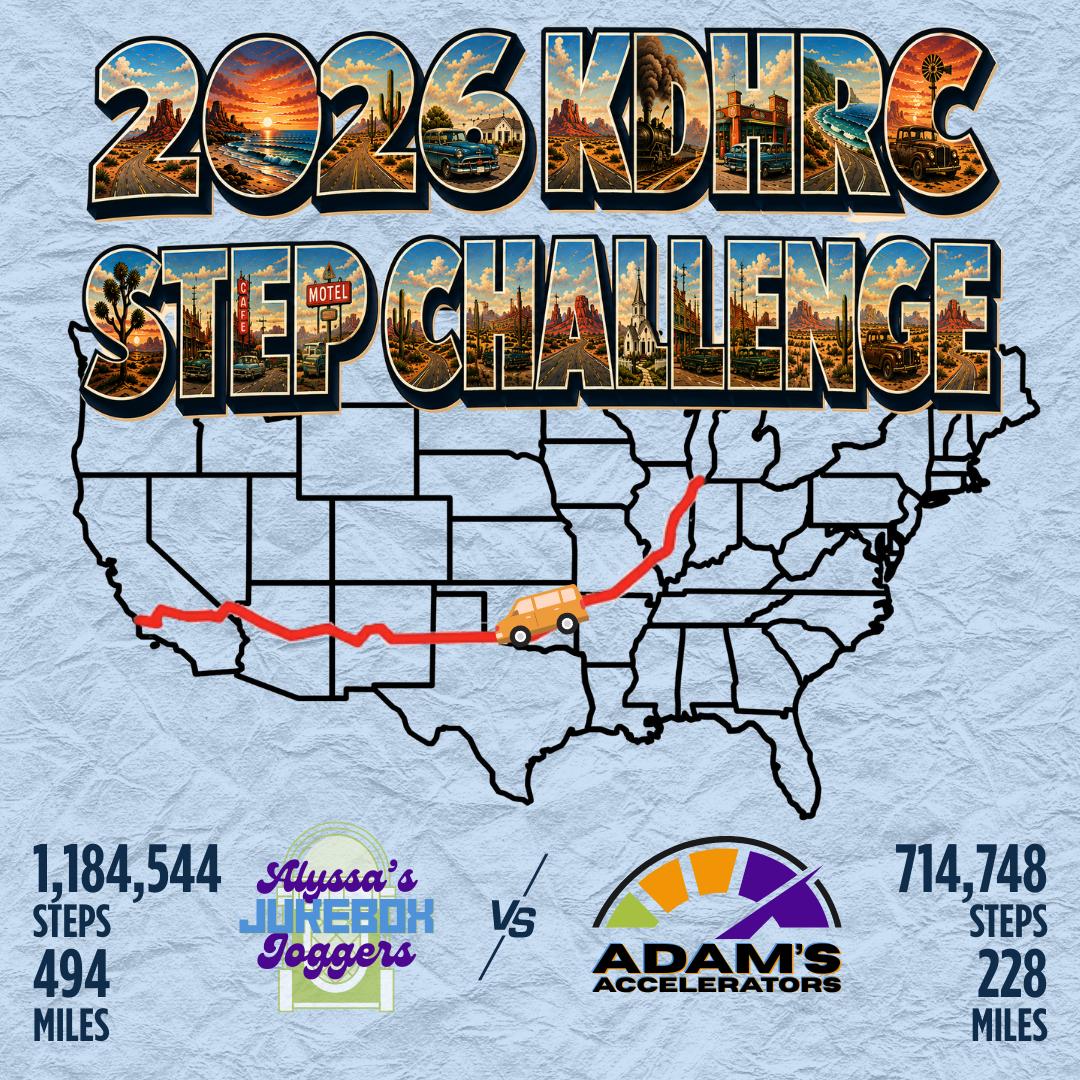
The KDHRC Step Challenge has wrapped up, and it is time to announce a winner!…

October is World Menopause Awareness Month
October is World Menopause Awareness Month!1 This month is a great time to raise awareness about the physical, emotional, and professional impacts of menopause on women. A KDHRC staffer recently attended a webinar hosted by the National Institutes of Health’s Office of Research on Women’s Health, which explored the experiences of mid-life active-duty service women navigating treatment for menopausal symptoms, highlighting systemic gaps in care.2
The webinar discussed a study based on interviews with women from all branches of the military, revealing common symptoms such as hot flashes, memory issues, and weight gain. Many participants faced significant barriers to care, including provider dismissal, a lack of menopause-specific knowledge, and disrupted continuity due to frequent moves and deployments. These challenges impacted not only their health but also career advancement and job performance.
Last month, KDHRC received funding from NIH to develop an evidence-based CHW professional development course to provide mental, emotional, and social outreach to women experiencing the menopausal transition (MT). MT refers to the period spanning from perimenopause to post-menopause in women.3 This transition is marked by various physical changes, such as reduced ovulation, hot flashes, and vaginal dryness. 3,4 Furthermore, MT is often accompanied by mental health challenges such as decreased self-confidence, mood swings, and frequent crying.4–7 KDHRC’s program Supplying Useful Perimenopause through Post-menopause Online Resources and Tools (SUPPORT) is a timely and desired program for CHWs to support women through this time period. Stay tuned for more updates on SUPPORT!
Works Cited
- World Menopause Day 2025 . (n.d.). International Menopause Society. Retrieved October 15, 2025, from https://www.imsociety.org/education/world-menopause-day-2025/
- Janvrin, M. (2025, June 12). The experiences of mid-life active duty service women accessing treatment for menopausal symptoms: a pilot study . Menopause and Midlife Health Webinar. https://orwh.od.nih.gov/events/menopause-and-midlife-health-webinar
- Harlow, S. (2022). 25 years of research shows insidious effect of racism on Black women’s menopausal transition, health. https://sph.umich.edu/news/2022posts/insidious-effect-of-racism-on-black-womens-menopausal-transition.html
- Takahashi, T. A., & Johnson, K. M. (2015). Menopause. The Medical Clinics of North America, 99(3), 521–534. https://doi.org/10.1016/J.MCNA.2015.01.006
- Takahashi K.M., T. A. & J. (2015). Menopause. Medical Clinics of North America, 99(3). https://doi.org/https://doi.org/10.1016/j.mcna.2015.01.006
- Dotlic Radovanovic S. Rancic B. Milosevic B. Nicevic S. Kurtagic I. Markovic N. Gazibara T., J. (2020). Mental health aspect of quality of life in the menopausal transition. Journal of Psychosomatic Obstetrics & Gynecology, 42(1). https://doi.org/https://doi.org/10.1080/0167482X.2020.1734789
- Aninye Laitner M.H. Chinnappan S., I. O. (2021). Menopause preparedness: perspectives for patient, provider, and policymaker consideration. Menopause, 28(10), 1186–1191. https://doi.org/https://doi.org/10.1097%2FGME.0000000000001819
- Sharman Moser Chodick G. Bar-On S. Shalev V., S. (2020). Healthcare Utilization and Prevalence of Symptoms in Women with Menopause: A Real-World Analysis. International Journal of Women’s Health, 12. https://doi.org/https://doi.org/10.2147/IJWH.S246113

Related Posts